Roundabouts vs. Signalized Intersections: Is Comparing Total Conflict Points a Valid Metric?

source:Texas Department of Transportation
Introduction: The Classic “32 vs. 8” Comparison
One of the most widely cited arguments in traffic engineering is the comparison between traditional intersections and roundabouts:
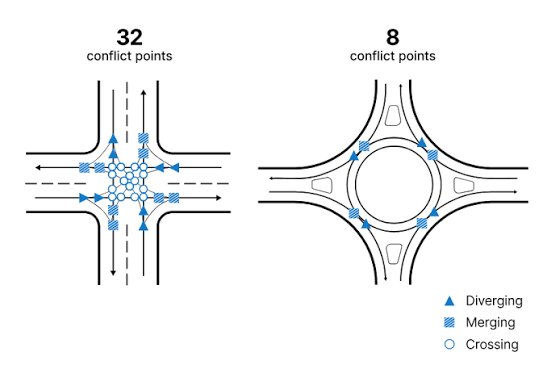
- A conventional four-leg intersection has 32 potential vehicle conflict points.
- A single-lane roundabout has only 8 potential vehicle conflict points.
This comparison is often used to explain why roundabouts are considered safer than conventional intersections. While this statement is not incorrect, it is frequently oversimplified.
The problem is not the numbers themselves—it is how they are interpreted.
Many discussions implicitly assume that fewer theoretical conflict points automatically translate into lower operational risk. In reality, intersection performance depends on much more than static geometry.
Conflict Points Describe Geometry, Not Real-Time Exposure
A conflict point is a potential location where two vehicle paths may intersect.
It does not imply that drivers are simultaneously exposed to every conflict point whenever they travel through the intersection.
The actual conflicts experienced by drivers depend on several operational factors, including:
- Traffic control strategy
- Signal phasing
- Traffic demand
- Vehicle speed
- Driver behavior
Therefore, conflict point counts should be viewed as a structural indicator, not a direct measure of operational safety.
Two Different Ways of Managing Conflicts
Although signalized intersections and roundabouts both manage conflicting traffic movements, they do so using fundamentally different mechanisms.
Signalized Intersections: Time Separation
Traffic signals reduce conflicts by separating incompatible traffic streams in time.
Consider a protected left-turn phase.
When the green left-turn arrow is displayed:
- Opposing through traffic is stopped.
- Cross traffic is stopped.
- The left-turn movement proceeds without searching for acceptable gaps.
From the driver’s perspective, the operational environment is relatively simple because conflicting movements have been separated by signal timing.
In other words, the intersection geometry still contains many potential conflict points, but signal control ensures that only a limited number of traffic streams operate simultaneously.
Roundabouts: Continuous Conflict Management
Roundabouts use an entirely different philosophy.
Instead of stopping conflicting traffic streams, they rely on:
- Yield control
- Speed reduction
- Gap acceptance
- Continuous vehicle interaction
Drivers entering a roundabout must continuously observe circulating traffic and determine whether an acceptable gap exists before entering.
Rather than eliminating conflicts through time separation, roundabouts manage them through low-speed interaction.
This creates a different driving task.
Drivers are continuously making decisions, but those decisions typically occur at much lower speeds than at conventional intersections.
Driver Workload Is Different from Collision Risk
This distinction is often overlooked.
A driver approaching a busy multilane roundabout may experience a higher cognitive workload because they must:
- Observe circulating vehicles,
- Select the correct lane,
- Judge acceptable gaps,
- Plan their exit.
By comparison, a protected left-turn movement at a signalized intersection usually requires much less simultaneous decision-making.
However, greater cognitive workload does not necessarily imply greater crash risk.
Modern roundabouts intentionally reduce:
- Vehicle speeds,
- Conflict angles,
- High-severity crossing collisions,
- Head-on collisions.
Even though drivers continuously interact with surrounding traffic, any resulting crashes generally occur at significantly lower impact speeds.
Therefore, operational complexity and safety should not be treated as equivalent concepts.
What Should We Actually Compare?
Instead of asking,
“Which intersection has fewer conflict points?”
traffic engineers should ask questions such as:
- Which traffic streams are operating simultaneously?
- How are conflicts managed?
- At what speeds do conflicts occur?
- What are the likely consequences if a conflict becomes a collision?
- How much decision-making is required from drivers?
These questions provide a much more complete picture of intersection performance.
Conflict Points Are Only One Piece of the Puzzle
The classic “32 vs. 8” comparison remains useful because it illustrates how different intersection geometries create different opportunities for vehicle-path conflicts.
However, it should not be interpreted as a complete explanation of safety.
Signalized intersections primarily manage conflicts through time separation.
Roundabouts primarily manage conflicts through speed control, yield behavior, and geometric design.
Both approaches reduce risk—but they do so in fundamentally different ways.
Conclusion
The debate should never be reduced to a simple comparison between 32 and 8.
Conflict point counts describe the potential structure of conflicts, not the complete operational experience of drivers.
A meaningful evaluation of an intersection should consider:
- conflict exposure,
- signal phasing,
- vehicle speed,
- conflict type,
- driver workload,
- and crash severity.
Only by examining how conflicts are actually managed—not merely how many theoretically exist—can we determine which intersection design is most appropriate for a given traffic environment.
Ultimately, good traffic engineering is not about minimizing the number of conflict points; it is about minimizing the likelihood and consequences of conflicts becoming crashes.